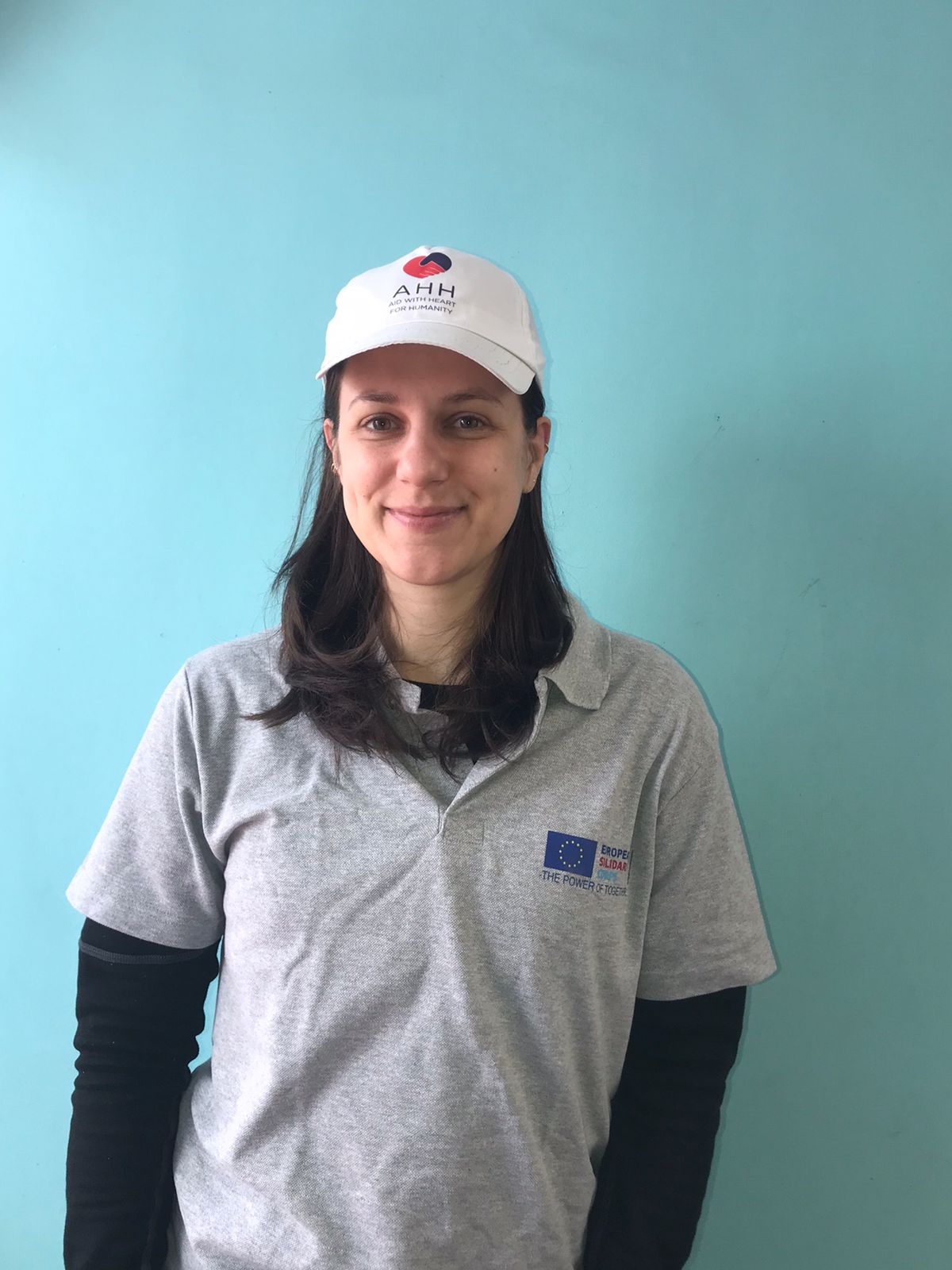
KATHRIN WEICHSELBAUMER-WIMMER
Volunteering Experience in Nepal
Week 1
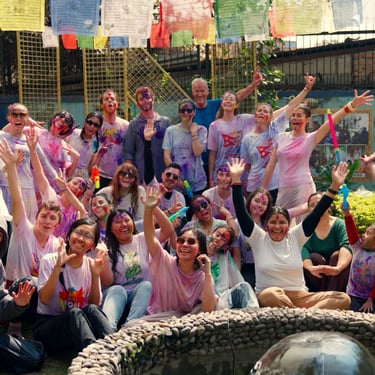
The first week was filled with discoveries — of the country, but also of the people. We are 20 in total, including volunteers from another European program. This first phase required some adaptation: cold showers, shared living spaces, and group discussions… Gradually, everyone is finding their place, and excitement about the project is growing day by day.
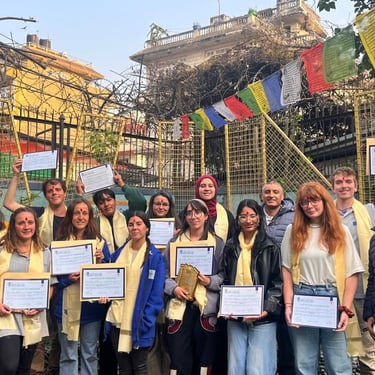
We had the opportunity to visit several key places in Kathmandu with Dinesh, one of our coordinators. It was a great moment. At Pashupatinath Temple, which is one of the most sacred for Hinduists. It’s dedicated to Pashupati, Shiva’s incarnation. The bodies of the deceased are brought to be cremated, allowing them to pass from life to death according to Hindu tradition. We then visited the Boudhanath Stupa - Tamal Jatra, a Buddhist place, where people come to express their devotion. Some places around offer a breathtaking view over the city. This visit sparked meaningful conversations about the different beliefs that coexist here in Kathmandu, and more broadly throughout Nepal.
After that, we set off on the road to Okhaldhunga — a journey around nine hours — to reach what will soon become our new home. Despite the long drive, the stunning landscapes made the time fly by, helped along by a few naps ! Upon arrival, we discovered a truly beautiful place. The building is impressive and sits proudly on a hill, overlooking the surrounding area.
Since then, we’ve continued to reflect on the project, forming small working groups to focus on specific topics. We’ve also had time to explore the village and its surroundings, getting a first glimpse of daily life here.
A wonderful first week — and I can’t wait to begin the next one.
Week 2
This week, we went to school for the very first time — well, at least one of them, as the other was unable to welcome us due to exams and local celebrations.
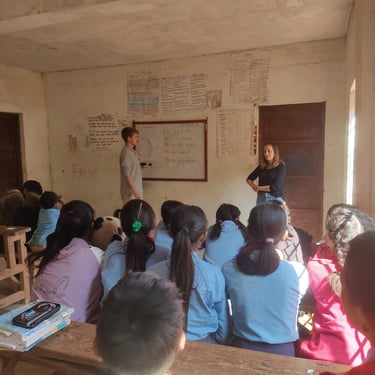
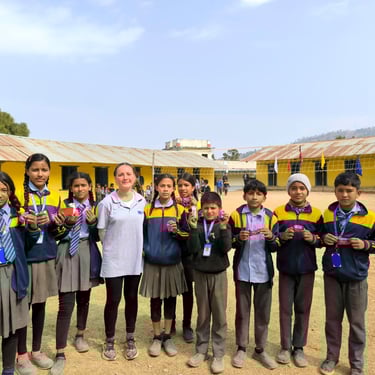
We therefore went to Karkala School, about a 40-minute walk from the center where we are staying. Our first visit went very well. Ramu, the Nepali volunteer, was able to talk with the school management, who allowed us to spend two class periods with the children (1 hour and 20 minutes). We introduced ourselves in Nepali (our names and countries), and then the children did teh same (name, age, grade). Their level of English is quite basic, and the ages are very mixed, ranging from 6 to 12 years old, and around 20 children, which means we need to find activities that can engage everyone.
We started with a drawing activity, which they all really enjoyed. Then we hung their drawings on the wall. After that, we played with them: some volleyball, others a traditional game similar to knucklebones using small stones, and we also discovered a Nepali game called carom, a nepali billiards. It was a very positive first meeting.
The next day, we went with other volunteers to their classes. We had the same meeting with the teachers, who once again allowed us to stay for two periods, with the older grades. We decided to split into smaller groups and then rotate. In one group, we worked on numbers, while in the other we played memory games. The activities worked well, and the children were happy and engaged. That evening, it was one volunteer’s birthday. We danced together, and it was a really fun and joyful moment!
The way after was off due to a local festival Maghe Sankranti. With some of the other volunteers, we went to a market that had been set up especially for the occasion. I stocked up on fruit and bought peanuts. We also got to try sugarcane — very juicy and sweet !
After that, we returned to Karkala School. This time, we played games focused on vocabulary and on expressing what they like. These activities gave us a better idea of the children’s level. They have a very good vocabulary, but they don’t speak much yet. With time, they will get used to us and become less shy. We then had a rest day, during which I was able to do some laundry. I took time to call my family and also went for a walk with other volunteers.
The following day, we were supposed to go to the other school, Kalika. However, due to the end of exams, the visit was cancelled. My group therefore had an extra day off. I went drawing with another volunteer in a small tea shop — a very pleasant moment.
Week 3
On Monday, it was a public holiday for Sonam Lhochar.
On Tuesday, we had our first visit to our second school: Kalika. The discussion with the teachers went very well. They assigned us to grades 10 and 11 for two class periods. They also invited us to come back on Friday for the Saraswati Puja celebrations. We met the students, introduced ourselves, and they did the same. Then we asked them to draw their families. The activity worked to some extent — everyone drew something, though not always their family. On our side, we made drawings to represent our respective countries. Their level of English is better than at Karkala, and the students are older. Based on the teachers’ requests, we will therefore focus more on sports and artistic activities with them.
On Wednesday, we planned the activities for the coming days.
On Thursday, we went back to Karkala. We had activities planned, but both teachers and students were busy preparing for the Saraswati Puja celebration the following day. So instead, we helped them with the preparations and played volleyball with some of the students. We were also able to enjoy the results of our work — and it was delicious! Rotis.
On Friday, we went to Kalika to celebrate Saraswati Puja. Saraswati Puja is very important in schools, as Saraswati is the goddess of knowledge and learning. Unfortunately, the day began with an accident: a student broke his arm. He was taken to Okhaldhunga for surgery, which understandably dampened the festive atmosphere.
Later on, the music was turned back on, some people danced, and we were able to connect more closely with the students in a context outside the classroom. We helped with the preparations and also took part in the ceremony by making offerings — rice, flowers, incense, and money — to bring prosperity. We shared a meal together, including rotis once again, which were really delicious. Afterwards, there was a spelling competition, followed by several speeches. We then walked back around 4 p.m., accompanied by two students — after having arrived at 8 a.m.!
On Saturday, I went to Okhaldhunga with other volunteers. We took jeeps to get there — a one-hour journey, squeezed four people onto a back seat meant for three. This trip helped me expand my Nepali music playlist. Once we arrived, we had a coffee or chai, did a bit of shopping, and went for a walk to the Saraswati Temple (Hindu) and Swoyambhu Chaitya (Buddhist). We then had lunch before heading back, as a meeting was waiting for us, along with the final rounds of a chess tournament organized by another volunteer for students from different schools.
Week 4
This week, we went twice to Kalika and twice to Karkala. We had days off on Friday and Saturday, which we used as an opportunity to travel to Halesi. And then go back to Kalika
On our first day at Kalika, we focused, as usual, on sports and artistic activities. We started with an icebreaker called the mirror: each student had to copy the movements of the person standing in front of them, then switch roles along the way. This activity worked only partially — it was a bit difficult for them to fully understand the concept, and the “lead” was not always taken over by the other student. We then moved on to a volleyball-based activity. Standing in two lines, they had to pass the ball from one side to the other until reaching the end of the line, making sure everyone touched the ball. This game worked much better!
After this warm-up, we divided them into four teams and had them play against each other until a winner emerged. They had a lot of fun, and we joined in as well, along with one of their teachers. Afterwards, we introduced a flexagram activity using a model, which they really enjoyed.
The following day, still at Kalika, we decided to play dodgeball. Before starting, each team had to create its own team logo. Both activities worked very well and were met with great enthusiasm.
On Wednesday, we went to Karkala. There, we focused on language development and self-confidence. We began with an activity around colors: sheets of different colors were placed on the walls, and the children had to touch the correct color when it was called out, while also naming an object or thing of that color. This class included very young children, but they were able to follow along. Next, we asked each child to read a sentence from a children’s book. We also asked them questions to check their understanding of the story. To finish, we worked on their English comprehension in a more physical way: the children lined up and jumped to the right for “yes” and to the left for “no,” depending on whether the statement we said was true or false. Finally, we asked them to give a color to their day, encouraging a more abstract reflection.
The next day, since we had asked the students what they wanted to explore further and they told us they wanted to learn more about our countries, we created a game around that idea. They had to match the correct elements to each country — flag, capital city, language, food, monument, instrument, and more. For the last few minutes, we played volleyball together.
After that, we had two days off, during which we traveled with other volunteers to Halesi, a sacred place for both Buddhists and Hindus, known for its temples built into caves. It was truly impressive and a wonderful experience. We used every possible means of transportation to get there, even traveling with goats on the roof and in the luggage compartment! A much-needed break that did us a lot of good.
On Sunday, we returned to Kalika. At the students’ request, we focused on sports and teamwork. We started by playing football, then volleyball, and finally showed them a few basic basketball moves.
Week 5
Week 5 was the busiest one since we arrived.
We started the week by returning to Kalika. Unfortunately, Salma, one of the volunteers, was experiencing severe knee pain, so we decided it was best for her to rest and not come with us. We therefore went to the school with only Danie and Ramu. That day, we focused on the continents. Each student received a country card with information about it. They had to present their country to the others and then locate it on a map. Afterwards, we repeated the activity we had done the previous week at Kalika about our respective countries. This time, it was a bit more challenging to manage, as the students were quite restless. We eventually presented the different elements ourselves, and Danie presented Egypt on Salma’s behalf. These activities took up the full 1 hour and 20 minutes, so we didn’t have time for sports.
The following day, Salma told us that she was in too much pain and wouldn’t be able to walk with us anymore. So it was with a bit of sadness that the three of us went to Kalika. We decided to start with a short meditation to avoid the same issues as the day before. Then, as a continuation of the country-related activities, we asked the students to create their own country: its name, flag, currency, national animal, and more. The activity worked really well! After everyone had presented their country to the group, we played the napkin game. This activity was also a success — it was a very good day overall.
The next day at Karkala, we only had 40 minutes. We therefore organized a game focused on introductions: the students had to match the right questions and answers depending on the information needed (first name, class, number of siblings, etc.).
We continued this activity the following day by doing a short grammar review on the use of be and do, followed by the creation of a paper “fortune teller,” where they could write any questions they wanted. They really enjoyed this activity.
Meanwhile, Salma was able to talk with the coordinators, who said they could organize a jeep at least once a week so she could get to Kalika. This is great news, as we were planning to organize a treasure hunt, and it wouldn’t be the same without her! On top of that, she should be able to organize activities with young people directly from the center, which is also very good news!
Finally, we ended the week at Karkala. We decided to work on synonyms and antonyms: each student had a word and had to find the two others that matched among their classmates. This activity didn’t work as well as we hoped, so we asked them to write three sentences for later, using at least one of the words they had learned. We then played dodgeball, which once again worked very well!
On Saturday and Sunday, some volunteers decided to travel to Pattaé, but I chose to stay behind and take some quiet time for myself. Living with so many people isn’t always easy!
Week 6
This week started a little differently.
On Monday, we didn’t go to school as both of my colleagues were feeling unwell. We used this unexpected free time to work on the mid-term presentation requested by Dinesh and to plan the activities for the week ahead.
On Tuesday, Salma was able to come with us to Kalika thanks to VIN, which had arranged a jeep for her. We were really happy this was possible, especially because we had planned a treasure hunt — and taking part in it meant a lot to her. We arrived early to hide the different clues around the school. The students were divided into three teams of eight. They absolutely loved the activity! They were running everywhere, full of energy and motivation. We had also planned to involve the teachers by asking them to act as clue guardians. They really embraced their roles, which made the whole experience even more fun. As a “treasure,” we had prepared cakes, which were, of course, very well received.
It was a wonderful moment — and also an opportunity for Salma to say goodbye. Unfortunately, the jeep cannot be arranged again, and she will have to travel to Kathmandu to see a specialist for her knee.
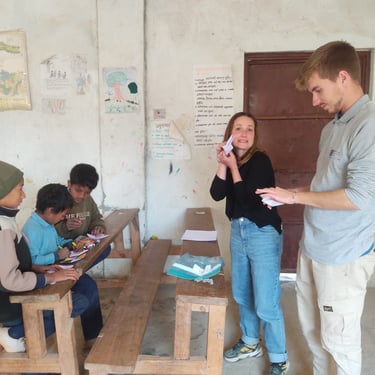
The next morning, we had the surprise of seeing some girls from Kalika come to the center. We listened to music and danced together. We thought we would see them again in the afternoon when we went to Kalika, but many students were absent due to a wedding. We ended up with a small class. As requested by VIN, we worked on the Wall Magazine project. The students created poems, drawings, and short presentations. Afterwards, we introduced them to origami — cranes, tigers, and paper fortune tellers. It was a pleasant session in a smaller group, much calmer than the previous week.
On Thursday and Friday, we were at Kalika again. We introduced the concept of a family tree and the vocabulary needed to talk about family members. The students then created their own family trees and presented them to the class to practice their speaking skills. The activity didn’t work as well as we had hoped, so we ended the session by making paper fortune tellers again.
The following day, we decided to organize more dynamic activities. We divided them into three teams. First, they had to answer general knowledge and math questions to earn points. Then, they rotated through three different workshops. The first focused on emotions: we described a situation, and they had to identify the emotion that matched it. The second was about actions: they were given four verbs to mime and then had to create a sentence using each one. The final activity involved finding “Where’s Charlie?” in the dedicated book. After all that, we played tag and hide-and-seek. It was a really fun and lively session!
The weekend was calmer. Some volunteers went to Halesi to celebrate Maha Shivaratri, the Great Night of Shiva — an important Hindu festival symbolizing infinity, purification, and the search for peace. As I am leaving the following week for a trek with other volunteers, I decided to stay in Nishankhe and rest. On Saturday, we went to Okhaldhunga to buy supplies in preparation. On Sunday evening, we celebrated Maha Shivaratri locally: villagers lit a bonfire and played music. A simple but beautiful way to end the week.
Week 7
Our first week of holidays felt like the perfect moment for an adventure. Along with four other volunteers, we decided to take a few days off to complete a three-day trek in the Himalayas, with one clear goal: reaching Dukhunda Lake.
The week before had been filled with preparation — and hesitation.
Were we truly ready for such an adventure?
Would we handle the altitude, climbing from 3,100 meters to a highest point of 4,600 meters?
How much food should we bring?
What clothes would keep us warm enough?
How do you pack everything you need… without making your backpack unbearably heavy?
After answering some of these questions — and deliberately ignoring others — we left early Tuesday morning at 6 a.m. for a six-hour jeep ride to the starting point of our trek: the village of Ringmo.
As soon as we arrived, we began our first climb — and what a climb it was. Over 700 meters of elevation gain, continuously uphill. It took us more than four hours, with many breaks along the way. Several volunteers began to feel the effects of altitude sickness. Still, we made it to our first refuge, arriving in the grey clouds of late afternoon.
We warmed up with tea and coffee, and then, as if rewarded for our effort, the clouds slowly cleared. The sunset revealed the Himalayan range before us — and even Everest in the distance. Later that night, we stepped outside again to admire a sky untouched by light pollution. The stars felt impossibly close. It was breathtaking.
The first night was slightly chaotic — apparently, a rat was sharing the refuge with us. I slept well nonetheless, though some of my fellow trekkers struggled with the cold and the altitude.
We woke up early to watch the sunrise over the mountain chains. It was a magical moment — one that filled us with joy and renewed motivation to continue climbing.
After breakfast, we set off again. This part of the trek was gentler, with rolling terrain and increasingly stunning landscapes. We stopped often — to take photos, to breathe, to simply exist in the beauty surrounding us.
We reached the second refuge around midday. After lunch, photos, and our now-traditional “Harlem Shake” video (a challenge we had set for ourselves at each stage), we took time to wander around the area and soak it all in. The night was colder than the previous one, so sitting around the stove before dinner felt especially comforting. No one dared to shower. We went to bed early, preparing for our final ascent to the lake.
We left at 8:20 a.m., after a slightly delayed breakfast. The final climb had begun. The landscapes grew even more dramatic — glaciers appeared in the distance, and along the way we found beautifully colored stones scattered across the ground.
After several hours of climbing, we finally reached Dukhunda Lake.
KATHRIN WEICHSELBAUMER-WIMMER
SUBSCRIBE
Subscribe to be updated about latest news and blog posts and to follow what is happening in a magical land of Bali.
Fatma Sümeyye Şahin
Çengelköy, Kalantor Sk. No:6 Üsküdar/İstanbul
Project Coordinator
Address
Telephone
+90 551 256 52 46