H. CARLOTTA WICHMANN
1st week in Lomé, Togo
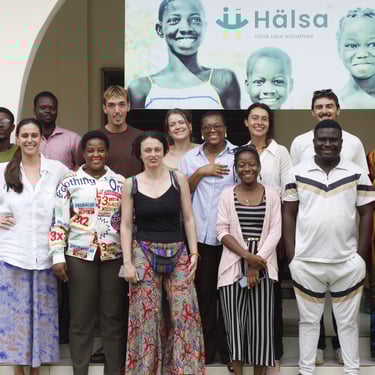
Upon our arrival at Lomé’s airport, we were picked up by Hälsa International’s social worker as well as their long-term individual volunteer and driven to the guesthouse, located about 20 minutes from the city’s city centre. The weekend before we were meant to start our work, the four of us visited a museum and went to one of the beach spots, getting to know each other as a group and getting used to the climate; a more-or-less constant 30 degrees during the day, with a humidity of about 85 per cent. Something I had only experienced at the Kenyan coast before.
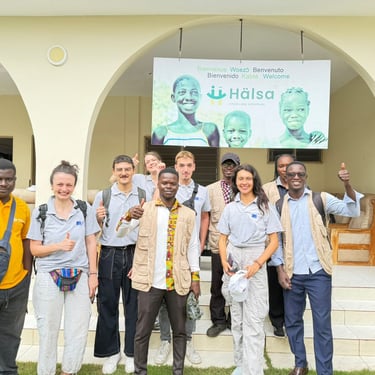
The first day at Hälsa International’s office, we were warmly welcomed to the team and given general information regarding the volunteering programme as well as a more detailed presentation about the work that the organisation does. Also, the introductory day included a small ‘lesson’ on Togolese culture and examples of the most important words and phrases in Ewe, one of the local languages spoken in the region, to use during our stay and daily work.
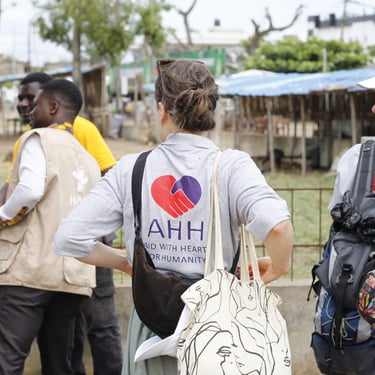
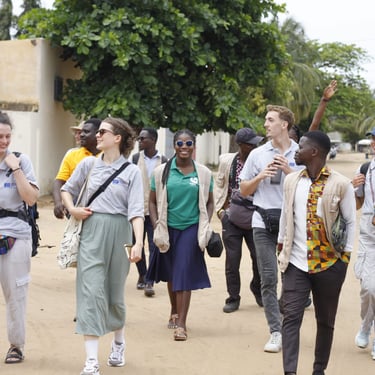
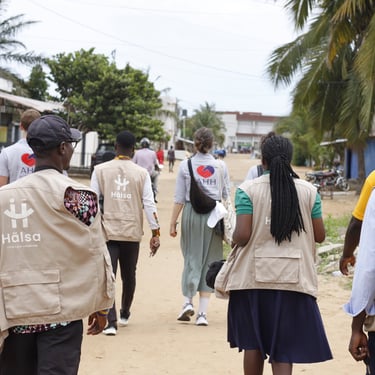
On our first day outside the office, our group went out into the streets of Lomé to find and register children living in the streets, an activity called “Maraude.” At first, we walked around without any luck but were able to speak to someone working in the area, who told us that kids usually start meeting up and playing in these streets around 1pm. We continued our round and only encountered one boy, sleeping on the stairs in front of a clothing store. It was only after lunch time that we saw more children. In the registration process – as a group of 1 volunteer and 1 local team member – we spoke with each one of the children separately, registering the names, ages and contact details for a family member. For (future) identification purposes, a photo of each child was taken.
Volunteering Experience in Togo
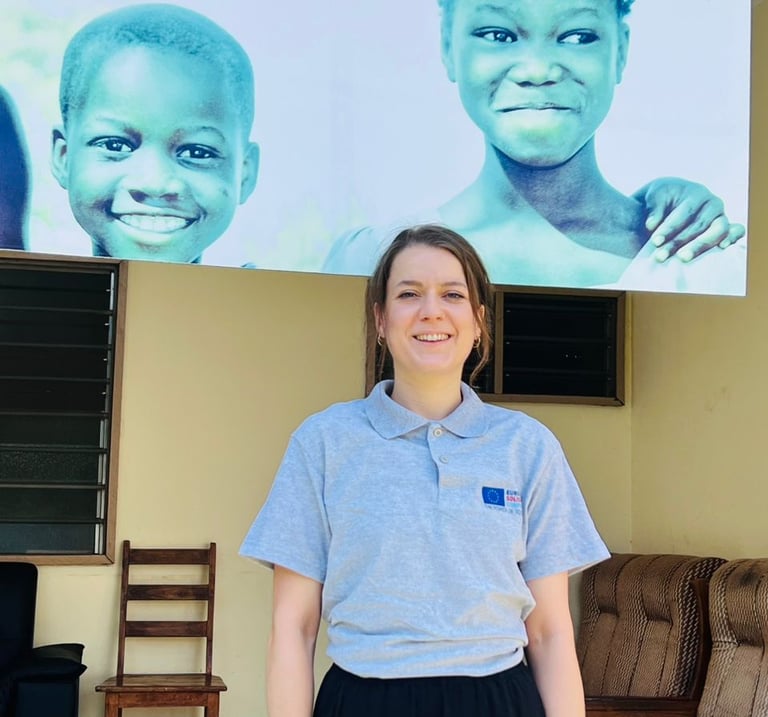
Afterwards, we continued our Maraude at another spot, a fruit and vegetable market in the North of the centre. Here, we encountered a group of children/teenagers, between the ages of maybe about 8 to 18 years old. Amongst this group was a set of siblings, who told us that the reason they are without housing is because their oldest brother went to jail and the father left the family. This first day working with street-connected children, I realised that most of them are male, especially the youngest ones.
Tuesdays and Thursdays are spent working at the organisation’s urban garden project, which supports single mothers living in the streets of Lomé. This urban garden project serves as a way for these young mothers to not only learn how to plant and grow vegetables, but to also serve as a source of income. Here, we supported them by harvesting the vegetables, watering the crop and preparing the sowing of new seeds.
On this second day working with Hälsa International, I realised that we mostly encounter boys, besides the young mothers that we are supporting within the urban garden project, underlining my previous impression: the children living in the streets (and often to be encountered in groups) are primarily male. Whereas street-connected girls and young women live separately from these male-centred groups. Furthermore, the realisation hit that littering is a permanent occurrence. There is garbage everywhere, something I hadn’t seen to this extent yet, even though I have lived and worked in Kenya before.
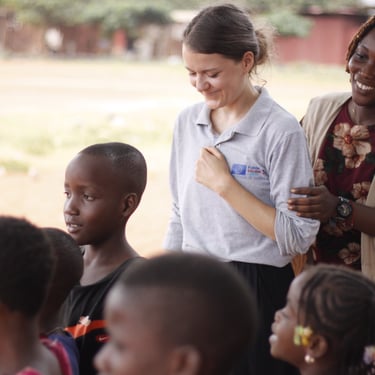
On our third day, we drove to a local playground to offer entertainment to street-connected children, which involved some football and other games, which are used to teach them about teamplay, respect and cooperation. There was a good amount of teasing and physical violence between the boys, something that the local team told us is quite a ‘normal’ way for them to handle conflict. This, however, led to younger and smaller boys watching on from the sidelines, rather than taking part in the games. One boy caught my eye that day, he was smaller than everyone else and quite slim built. He really wanted to shoot hoops but was pushed around by other boys who were older, taller and stronger than him. When I told him that I would make sure that he could give it a try, he gave me a big smile.
In the afternoon, I was able to support the food distribution for the kids. Food distributions are made possible because Hälsa International cooperates with local restaurants that donate bread and pastries. Even though the local team told the boys to line up, chaos broke out soon, which included fighting over who should be able to stand first in line. There was lots of pushing and yelling, some throwing of hands on the sidelines. My reflections after the distribution I also shared the team at the end of our first week: The way in which the children said 'thank you' for the food made me uncomfortable. We – another volunteer and I, two white women – were handing out bread to this group of street-connected boys. All of them smiled big and said, ‘thank you,’ but some of the went as far as to curtsy or take a bow.
2nd week in Lomé, Togo
Last week, I was nominated as the group’s ‘team leader,’ meaning that I was now serving as the representative of our group for the rest of our stay. With this, I represented the 5 of us at the organisation’s weekly Monday morning meeting, where the past week is recapped and the plans for the upcoming week discussed, including the volunteering activities. For this week, we were made aware that a potential partner organisation – le Soleil dans la Main – was going to visit the organisation and its projects.
On the day of the visit, we – the local and volunteering team – split up. Half of us drove to the urban vegetable garden, to harvest the vegetables, uproot weeds and water the plants, before the representatives’ arrival. I was part of the team that drove to Djena beach to mobilise children living in the area. Once we had invited them to join us at Hälsa International’s safe space – a small office located by the beach – Liman, the organisation’s psychologist, conducted a playful awareness session with them around the topic of ‘family.’ Afterwards, the children were invited to artistically express their view on what family means to them by using paint and canvases provided by us.
The next day, we returned to the playground we had visited the week before. Here, we brought the so-called ‘Mobile Ecóle’ with us, used to engage street-connected children in educational activities. Since many of them haven’t been attending school in quite some time, this method is used to playfully foster the children’s mathematical and writing skills, as well as broaden their vocabulary.
My highlight of the second week was a presentation that I was able to prepare and hold together with Liman; an information session to spread awareness regarding sexualised violence amongst the young women and mothers living on the beach. For this, I gathered the most important facts, answering the questions of what sexualised violence is, who the perpetrators can be and what consequences often follow incidents of that nature. We held the presentation at their sleeping spot on the beach. After the initial presentation of the information, we were able to answer questions that the women had. We also shared the info with them that Togo has a free hotline that they can call in case they need help.
3rd week in Lomé, Togo
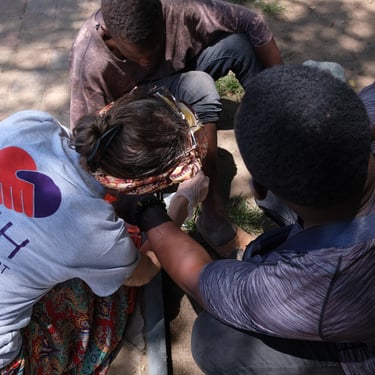
On Tuesday of this week, I had taken over a different task than the rest of the team. I have a paediatric nursing degree, something that I was able to put to use during my first two weeks working with Hälsa International, since many of the children come to us with existing injuries. Whilst I was inspecting the wounds, I realised that the organisation’s first aid kit was running low on materials and that most of the disinfectants were out of date. So this day was spent driving to the pharmacies in the area, to ask for the estimated prices of the items that were needed to stock up the first aid kit for future purposes.
On Wednesday of this week, the 5 of us were split up and working on different tasks; something that gave me more confidence in using my (limited)French vocabulary, since I was paired with Liman – Hälsa International’s psychologist – whose English vocabulary was just as limited. Together, we mobilised a group of children at a playground outside of the city centre. The day prior, I had been put in charge of organising an activity for this morning. I decided to translate the lyrics to an interactive song about ‘consent’: Ce sont mes parties intimes, personne ne le doit toucher. Et si on te les touches, je vais prévenir ma mère, mon père, et mon professeur. Translation : These are my private parts, no one may touch them. And if someone touches them, I will tell my mother, my father, and my teacher.) As the start to the activity, Liman and I sang the song for the kids that included movement as well, to make it understandable and ‘fun’ for all. As the second part – and a tool to solidify the exercise – I used a method that I had encountered working as a workshop coordinator in the past. I had come up with declarations/statements regarding the topic of consent and someone’s ‘private parts.’ A line drawn into the sand served as a spectrum between ‘I agree’ and ‘I disagree,’ making for a good conversation starter amongst the children and Liman and myself. All in all, this activity felt very fulfilling, since I felt like my small input had an impact on a larger number of children. This was particularly manifested in the children still humming the melody to the song late into the activity.
On Friday morning, we drove down to the beach to mobilise women and girls for a presentation on sexual- and reproductive health, held by the organisation ForHER. Once we arrived on the beach, we were informed that the police had come at night and burned people’s belongings, a tactic used on the regular, with the aim to disperse persons without housing. We were able to mobilise a good number of young women and their children, but they were visibly shaken after a stressful and anxiety-filled night. The awareness raising session was primarily focused on periods and the menstrual cycle and also offered a safer space to the attendees to ask questions and discuss concerns.
4th week in Lomé, Togo
This last week spent working with Hälsa International, we conducted interviews with young women and single mothers living on the beach of Lomé. The questionnaire for these interviews was written by Oscar, one of the 5 of us, and meant to gain insight into the most pressing needs and concerns that the women faced these days. I was able to conduct three interviews, with the help and support of Liman. Together, we spoke to young women that told us how long they have been living on the beach and how this living situation makes them, understandably, feel unsafe. The women we interviewed told us how little money they have. By asking for money in the streets, they make a maximum of the equivalent of 3 EUR a day. The biggest wish for them was to learn a profession, seamstress or hairdresser, this is the dreams they shared with us.
To have us experience the registration of children (‘Maraude’) not only by day but also by night, we were invited to join the team on a night Maraude in the streets of Lomé. During this workday we encountered a group of boys that were roaming the streets together, two of them needed medical attention. This activity will remain the most memorable to me, due to two reasons: it showed me the different side of the life in the streets of Lomé, particularly because in the area where the guesthouse for us volunteers was located, we hadn’t encountered any street-connected children. But on this day, we were able to see people gathered around a fire, boys roaming the streets as part of a larger group and women sleeping in the streets, together with their children. Also, this was the first time that I heard one of the children that we spoke with say that they had experienced sexual abuse. Being there on that day, in this moment – at the “right place” at the “right time” – was heartbreaking and beautiful at the same time: I was able to direct this boy to Hälsa International’s psychologist, she was able to speak with him and let him know that we were there to help. On this day, he became part of the street-connected children registered with the organisation and will hopefully reach out to the team in the future.
As part of my impressions gathered volunteering with Hälsa International for almost 4 weeks, I wanted to give the team a ‘crash course’ on wound management and observation. Something that usually a nurse on staff would be tasked with, but since the team didn’t currently have a nurse as part of the team, I had prepared a presentation, particularly aimed at furthering their knowledge on wound observation and knowing when a child should be referred to a hospital and/or doctor.
On the last day, we were given the opportunity to say goodbye to a group of mothers that we had been working on the urban garden with, having also entertained their young children in the meantime, to give them space to learn. Thankfully, we didn’t send them ‘home’ empty-handed but were able to gift them donated clothes and shoes for the children.
All in all, the volunteering experience was short-lived but insightful. I have learned a lot and noticed a personal growth that I hadn’t experienced during my time as an individual volunteer in the South Caucasus. These 29-days were challenging in different ways but provided me with an experience that I wouldn’t want to miss. The opportunity to provide input and design awareness sessions independently, helped me gain confidence in my knowledge and abilities, and furthered my understanding of the work that needs to be done when combatting sexualised violence. Thank you to the entire Hälsa International team for hosting us and for making this experience what it was!
H. CARLOTTA WICHMANN
SUBSCRIBE
Subscribe to be updated about latest news and blog posts and to follow what is happening in a magical land of Bali.
Fatma Sümeyye Şahin
Çengelköy, Kalantor Sk. No:6 Üsküdar/İstanbul
Project Coordinator
Address
Telephone
+90 551 256 52 46